
Lucy Foley's Miss Marple Novel Murder at the Grand Alpine Hotel and What It Means for Christie's Detective
Miss Marple is back in a full-length novel for the first time since 1976. Murder at the Grand Alpine Hotel, by Lucy Foley, came out this week from HarperCollins in the UK and William Morrow in the US. It is the first new Marple novel authorised by the Christie estate. Christie's own last Marple book, Sleeping Murder, was published posthumously fifty years ago.
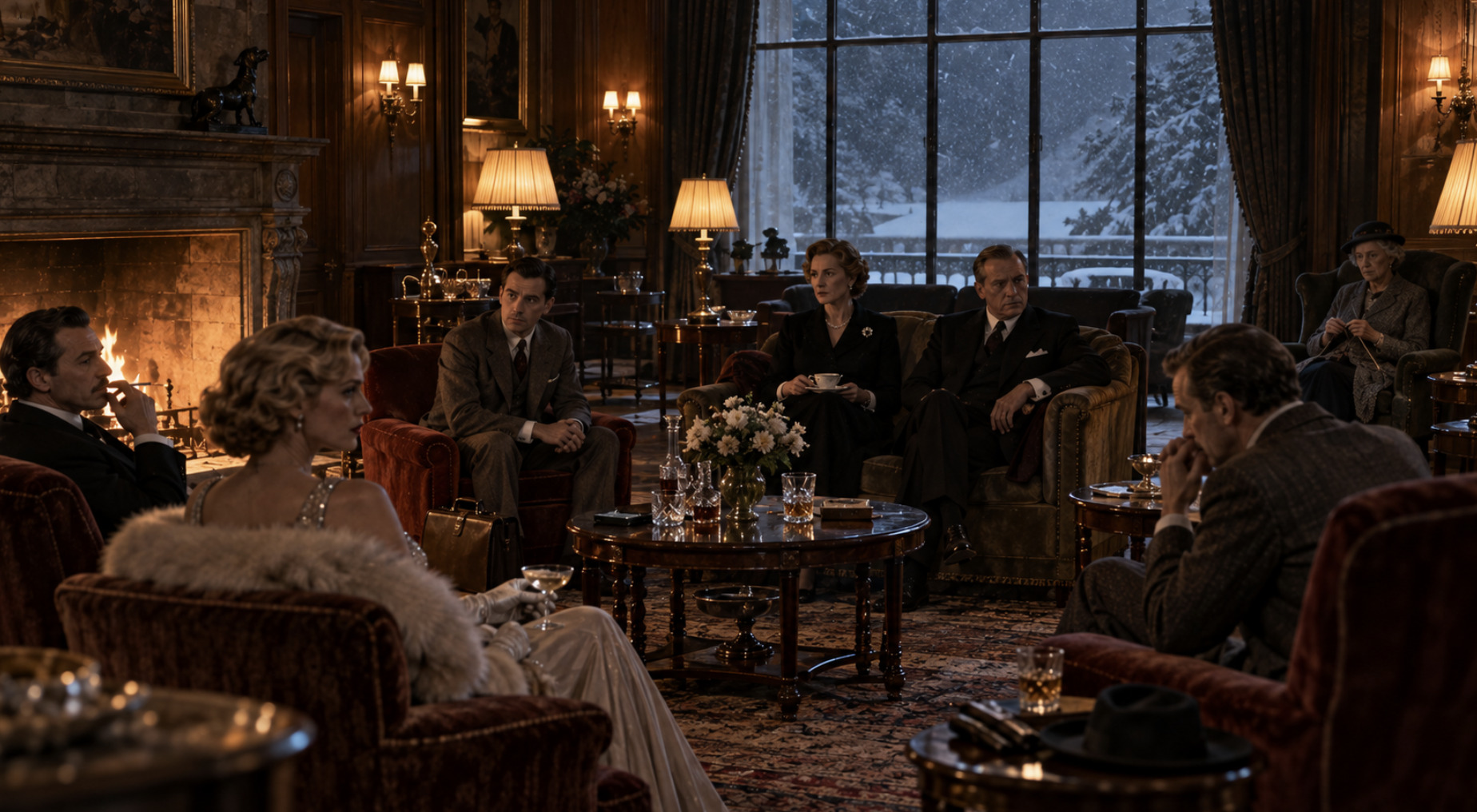
In short: the novel is set in 1950 at a luxury hotel in the Swiss Alps. A guest is found dead in a gondola, a blizzard cuts the hotel off, and Jane Marple, on holiday with her old friend Dolly Bantry, has to identify the killer from a closed circle of suspects. It is a traditional period whodunnit, written by a novelist best known for twisting modern thrillers. Most of the interest in the book, and most of the disagreement about it, comes from how those two sensibilities fit together.
What Happens in Murder at the Grand Alpine Hotel
The set-up follows Christie's approach: a glamorous, isolated setting, a small group of guests who all seem to be hiding something, and a detective nobody takes seriously.
The Grand Alpine sits high above a Swiss valley. The only way up is by gondola, which runs only at set hours. Miss Marple has come with Dolly Bantry, whom Christie readers know from The Body in the Library and The Mirror Crack'd from Side to Side. Dolly has also brought a paid companion, Diana Glass. The other guests match the kind of cast Christie liked to assemble: a rising British politician and his wife, a glamorous American actress, a young doctor, a French detective and a small-time crook. Some early readers also mention a group of nuns.
One morning, a guest who stepped into a gondola alive is found dead when it reaches the top. The weather then closes in and nobody can leave the mountain.
Plot descriptions from the publisher and reviews stop around there, and so does this article. Foley's publicity has highlighted one idea from the book: that the real question is not who had a motive, but who will die next. That suggests the first body won't be the last.
Is It an Official Miss Marple Book?
Yes. That is what separates it from the many Marple-style pastiches in bookshops. The novel is authorised by Agatha Christie Ltd, and Christie's name appears on the cover alongside Foley's, as it does on the estate's other continuation books.
It isn't the first authorised new Marple material, but it is the first full novel. In September 2022, HarperCollins published Marple: Twelve New Stories. That anthology gave the character to twelve writers: Naomi Alderman, Leigh Bardugo, Alyssa Cole, Lucy Foley, Elly Griffiths, Natalie Haynes, Jean Kwok, Val McDermid, Karen M. McManus, Dreda Say Mitchell, Kate Mosse and Ruth Ware. They were asked to set their stories within the period Christie's own Marple books cover.
Foley's story in that collection had Miss Marple visiting an old school friend whose village was holding its own version of Halloween. Several readers have since wondered whether the anthology was in effect an audition for a novel. There is no public evidence either way, so it is best treated as reader speculation. What is clear is that Foley had already written the character once before taking on a full book.
The obvious comparison is Sophie Hannah's Hercule Poirot novels. Those started with The Monogram Murders in 2014 and showed that a living author could keep a Christie detective going with the estate's backing. Until now, Marple had not had an equivalent.

Where the Novel Fits in the Marple Timeline
Setting the book in 1950 puts it in the busiest part of Christie's Marple career.
YearMarple bookWhy it matters here1927"The Tuesday Night Club" (short story)Miss Marple's first appearance1930The Murder at the VicarageFirst Marple novel1942The Body in the LibraryIntroduces Dolly Bantry's household at Gossington Hall1950A Murder Is AnnouncedChristie's Marple novel of the same year Foley's book is set1950 (setting)Murder at the Grand Alpine Hotel (Foley, 2026)Miss Marple abroad, with Dolly Bantry1962The Mirror Crack'd from Side to SideDolly returns, older and widowed1964A Caribbean MysteryChristie's own Marple-on-holiday novel1965At Bertram's HotelChristie's Marple hotel novel1976Sleeping MurderLast Christie Marple novel, published after her death
Two points follow from this. First, putting Miss Marple somewhere foreign and luxurious has a precedent in Christie herself. A Caribbean Mystery sends her to the West Indies, and At Bertram's Hotel is built around a hotel whose calm, old-fashioned surface hides something else. Foley's Alpine hotel draws on both.
Second, placing the book in 1950 means Foley is writing a Marple at the height of her powers: still sharp and active, before the frailer character of the late novels. It also puts the story in a post-war Europe where money, class and wartime secrets were all unsettled, which gives a closed-circle mystery plenty of material.
How Foley Writes Miss Marple
A thriller writer's structure in a whodunnit
Foley's own novels are closed-circle thrillers told by several narrators. The Hunting Party (2018) snows in a group of old friends at a remote Scottish lodge over New Year. The Guest List (2020) traps wedding guests on an island off the Irish coast. The Paris Apartment (2022) and The Midnight Feast (2024) work the same way, telling the story from several points of view and hiding key facts between them.
Murder at the Grand Alpine Hotel keeps that method. Reviews confirm that Foley uses multiple first-person narrators, which Christie rarely did in the Marple books. Christie mostly told her stories from outside, with the occasional narrator such as the vicar in The Murder at the Vicarage.
This is the book's main formal gamble. Advance praise from other crime writers has focused on it. Alex Michaelides, for example, singled out Foley's shifting points of view as the thing that stops the book being mere pastiche. It also affects how readers experience the mystery. When each suspect speaks for themselves, the reader is effectively invited to cross-examine them. Miss Marple, meanwhile, watches from outside those voices, just as she watches from the edge of the room in the originals.
Miss Marple herself
Early reviews agree more on this than anything else. BookPage wrote that Foley's Marple is almost impossible to tell apart from Christie's, solving the case through close observation and her store of experience of human nature. Several reader reviews say they could hear Joan Hickson's performance while reading.
In a radio interview around publication, Foley said that most people know a Miss Marple, and that both of her grandmothers had some of the character's qualities. That fits with the way she treats Marple: as someone to be taken seriously, not a figure of cosy nostalgia.
It also connects to something Christie built into the character from the beginning. Marple's advantage is that people underestimate her. An elderly, unmarried woman knitting in a hotel lounge is effectively invisible to the politicians, doctors and actresses around her, and that invisibility is how she finds out what they are hiding. Crime writers have discussed this for decades. The idea of Marple as a feminist figure was raised publicly when the 2022 anthology came out. It will now get a new round of attention, because a woman author has taken over a woman detective in a novel full of characters who assume she doesn't matter.
Early Reception So Far
The book has only just been published, so any account of its reception is provisional. Here is where things stand in the first week.
Professional reviews are strongly positive so far. BookPage called it a tightly plotted mystery that stays firmly in the 1950s while also feeling modern.
Advance praise from other writers has been enthusiastic, which is standard for a lead autumn title. Freida McFadden, Laura Dave, Chris Whitaker, Clare Leslie Hall and Alex Michaelides all provided endorsements. Readers should treat these as publicity material, not independent criticism.
Reader reviews are more mixed, though mostly warm. Readers who love Christie are largely delighted by how well the period detail and tone are handled, and several want more. The most common criticism comes from readers who otherwise enjoyed it: that the ending is over-engineered, with too many deliberate misdirections by the finale. At least one reviewer also noted that the book has slightly more sexual content than Christie's originals. That is a matter of taste, but it matters to some readers.
That split is what you would expect. The things Foley's thriller readers enjoy, such as layered reveals and rapid reversals, are exactly what a strict Christie purist may find excessive. Whether the ending plays fair is something each reader will judge for themselves.
Do You Need to Read the Original Marple Books First?
No. The novel is written as a standalone, and the mystery doesn't depend on knowing earlier cases. Long-time readers will get more out of it, though:
Dolly Bantry brings history with her. Readers who know The Body in the Library will recognise the friendship between two women who have been through a case together before.
Christie's own Marple-on-holiday novels, A Caribbean Mystery and At Bertram's Hotel, are the closest companions if you want to see how Christie handled Miss Marple away from St Mary Mead.
A Murder Is Announced, published in the year the novel is set, is the best single Christie to read alongside it. It shows Marple at the same stage of life, dealing with a post-war world in which nobody is quite who they say they are.
For readers coming to Marple through Foley, the reverse route works too. Murder at the Grand Alpine Hotel is an easy way into the originals.
What It Could Mean for the Future of Miss Marple
The next part of this story is less certain, so the facts need separating from reasonable inference.
What is confirmed: the book exists, it is authorised, and it is being marketed as a major release on both sides of the Atlantic.
What is not confirmed: whether Foley will write another. In the coverage available at publication, no second Foley Marple novel had been announced. Several reviewers openly hope for one.
The reasonable inference: the estate has now tested Marple in three forms, with the 2022 anthology, this novel, and many years of screen adaptations. The Poirot continuations show what can happen when a continuation book finds its readership: it can become a series. If Murder at the Grand Alpine Hotel sells the way Foley's thrillers have, a follow-up looks commercially logical. That is inference, not information. Sales figures, and any announcement from HarperCollins or Agatha Christie Ltd, are what to watch.
A wider change is already visible. In the last few years the classic whodunnit has moved from being a nostalgic sideline back into the commercial centre of crime publishing, through cosy crime, locked-room revivals and closed-circle thrillers. Foley's own books are part of that shift. Giving her Christie's detective links the older tradition and the newer one directly.
Frequently Asked Questions
When was Murder at the Grand Alpine Hotel published?
This week, in September 2026: by HarperCollins in the UK and William Morrow in the US.
Is it the first new Miss Marple book since Agatha Christie died?
It is the first new full-length Marple novel authorised by the Christie estate since Sleeping Murder (1976). The authorised short-story anthology Marple: Twelve New Stories came out in 2022.
When is the novel set?
1950, in a hotel in the Swiss Alps.
Which Christie characters appear besides Miss Marple?
Dolly Bantry, Miss Marple's friend from The Body in the Library and The Mirror Crack'd from Side to Side, travels with her.
Is it a cosy mystery?
Mostly, yes. It is a period whodunnit with a closed circle of suspects and little on-page violence. Foley's multiple narrators and twists give it more of a modern thriller's pace than Christie's originals.