
The Truth About Tax on Gambling Winnings in the UK
Ask a room full of British bettors whether they owe tax on a big win, and you will get a surprising range of answers. Some are convinced HM Revenue & Customs takes a cut of anything above a certain threshold. Others have heard that professional gamblers are treated differently. A few assume the rules must mirror those in the United States, where gambling income is very much taxable. The confusion is understandable, because gambling and tax are both subjects people find intimidating, and the internet is littered with half-remembered advice. The reality in the United Kingdom is refreshingly simple in its headline, and genuinely worth understanding in its detail.
This guide sets out where the money actually goes, why the system works the way it does, and the handful of situations where the simple answer needs a footnote. None of it is tax advice tailored to your circumstances — for that you would speak to an accountant — but by the end you should understand the UK position better than most of the pages that currently rank for the question.
The short answer, and why it surprises people
In the UK, if you place a bet or play a casino game as a punter, you do not pay tax on your winnings. Whether you win ten pounds on a slot, a few hundred on the football, or a life-changing jackpot, the amount that lands in your account is yours in full. There is no gambling winnings tax for the individual player, no declaration to make on a self-assessment return for the win itself, and no threshold above which a levy suddenly applies.
This surprises people for two reasons. The first is that money changing hands usually attracts the attention of the tax system in some form, so an entirely tax-free windfall feels like an anomaly. The second is cultural contamination from abroad, particularly from American coverage, where gambling winnings are reportable income and casinos issue tax forms for large payouts. British players absorb that framing from films, forums and imported articles and assume it applies at home. It does not. The UK made a deliberate choice, decades ago, to tax the industry rather than the individual, and that choice is the key to everything else.
Where the tax actually falls
The system did not simply decide that gambling should escape taxation. It relocated the tax from the player to the operator. Rather than skimming a percentage from each winning punter — an approach that would be administratively nightmarish and easy to avoid — the government taxes the companies that run the betting and gaming. Operators pay duties on their gambling activity, and those duties are calculated on the business rather than on any individual customer's good day.
The practical effect is that the tax is baked invisibly into the economics of the industry, funded out of the margin that betting and gaming naturally generate over millions of customers. A bookmaker or casino pays its duty regardless of whether a particular player wins or loses, which is why your personal outcome is irrelevant to the tax authorities. From HMRC's point of view, the taxable event is the operator's trade, not your fortune. This is the single most important thing to grasp: the UK taxes the supply of gambling, and the punter sits on the far side of that line entirely.
Why the UK chose this model
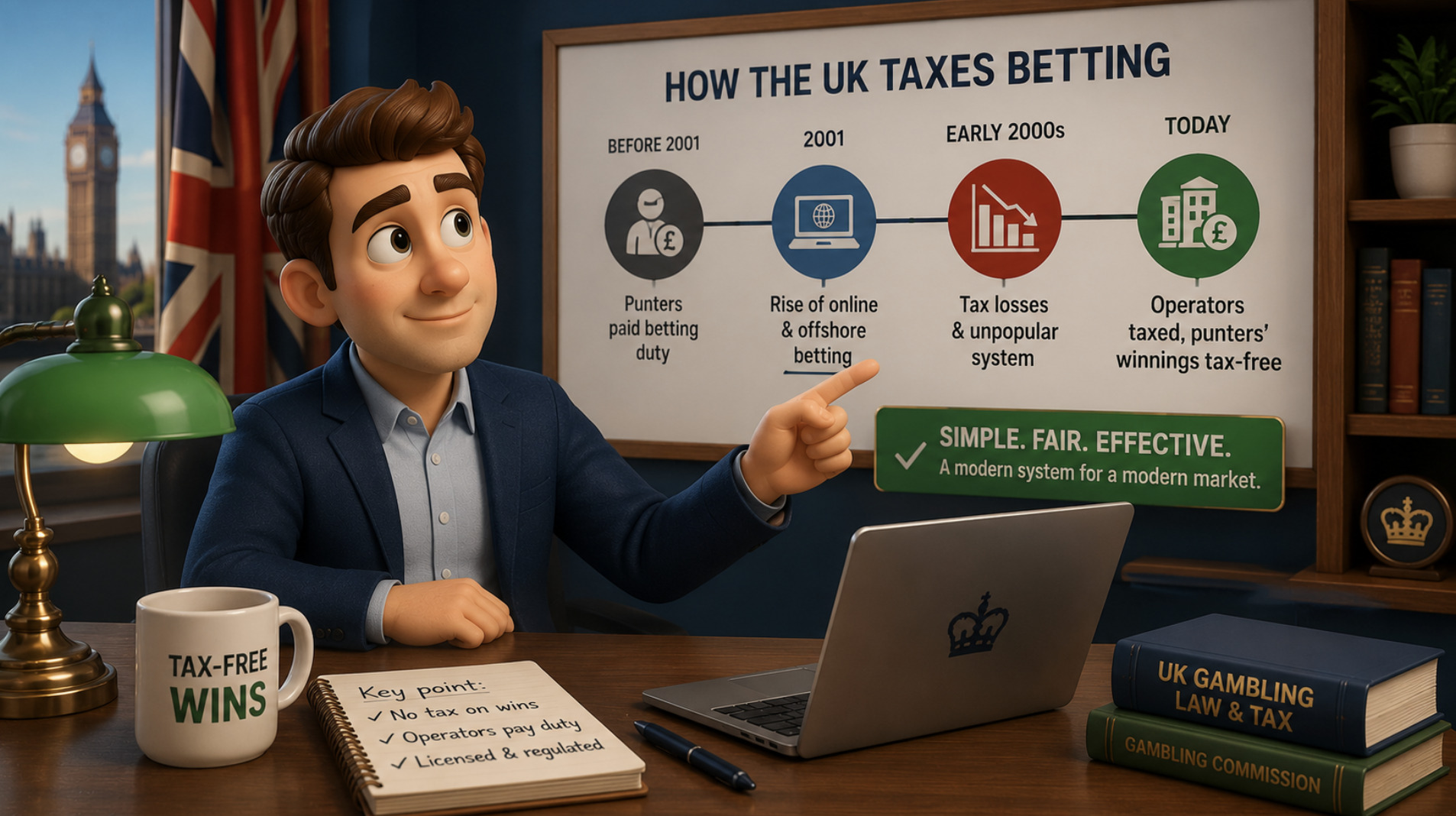
The current arrangement is not an accident of history but the result of a deliberate reform. For a long period, British punters did pay a betting duty, typically deducted at the point of placing a bet, and it was widely disliked. The turning point came at the start of the 2000s, when the tax on the punter was abolished and replaced with a system that taxed operators instead. The change was driven by a very practical problem: the rise of online and offshore betting.
When betting moved online, punters could simply place their bets with operators based overseas to escape the domestic duty, and the tax was quietly haemorrhaging as a result. Taxing the individual had become both unpopular and ineffective. Shifting the burden onto operators, and later requiring operators serving British customers to be licensed and to pay duty regardless of where they were based, solved both problems at once. It removed the incentive for punters to flee offshore, and it captured revenue from the whole market rather than the shrinking slice that stayed onshore. The tax-free win, in other words, is a by-product of a policy designed to make the system workable in an internet age, not an act of generosity toward gamblers.
The professional gambler question
The most persistent piece of nuance concerns people who gamble for a living. Surely, the thinking goes, someone who makes their income from betting must be taxed on it like any other self-employed earner? This is where the UK position becomes genuinely interesting, and where a great deal of misinformation circulates. The general position established through case law is that gambling is not a "trade" for tax purposes, even when it is done systematically and profitably, and that gambling winnings therefore do not become taxable income simply because a person is skilled or consistent.
The reasoning is that betting is regarded, in law, as a matter of chance rather than a taxable vocation, and that a run of success — however sustained — does not transform winnings into trading profits. A professional poker player or sports bettor in the UK generally does not pay income tax on their winnings for the same reason a casual player does not. This is a genuinely unusual feature of the British system and one that draws envious attention from gamblers in other countries. That said, the boundary is not something to treat casually, because arrangements that dress gambling up as a service or a business — being paid to play, for instance, or running a betting operation rather than betting in it — can fall on the taxable side of the line. Anyone whose situation is anything other than straightforwardly placing their own bets should take proper advice rather than rely on a general rule.
Where the simple answer needs a footnote
The winnings themselves are tax-free, but money rarely sits still, and it is what happens next that can attract tax. This is the distinction that trips people up, and it is worth stating plainly: the tax-free treatment applies to the act of winning, not to everything you subsequently do with the money. A few common situations illustrate the point.
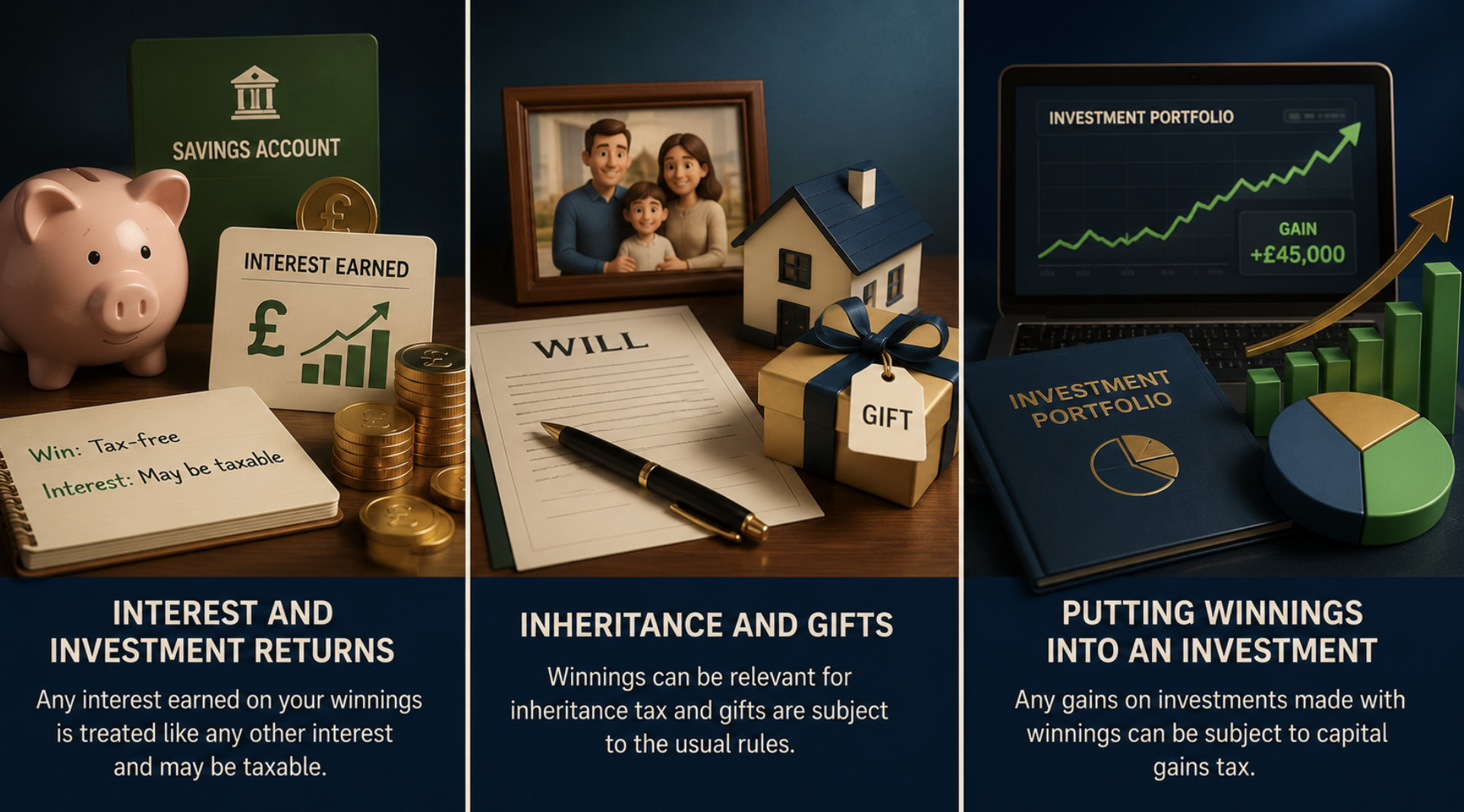
Interest and investment returns. If you deposit a large win into a savings account, any interest it earns is treated like any other interest and may be taxable under the normal rules for savings income. The win was tax-free; the interest it generates is a separate matter.
Inheritance and gifts. Winnings that form part of your estate can be relevant for inheritance tax in the ordinary way, and giving large sums away carries the usual gifting considerations. Again, the win is not taxed, but the money becomes part of your wider financial position and is governed by the rules that apply there.
Putting winnings into an investment. If you use winnings to buy assets that later grow in value, any gain on those assets can fall within capital gains rules. The gambling win is not the taxable event; the investment gain is.
None of this contradicts the headline. It simply reflects the fact that once a tax-free win becomes ordinary money in your account, it is governed by the same rules as any other money you hold. The clean line is around the winning itself.
The consumer-protection dimension people overlook
There is a further reason the tax question matters that has little to do with tax and everything to do with where you play, and it deserves emphasis because it is so often missed. The tax-free position for players is tied to a licensed, regulated market. Operators serving British customers are required to hold the appropriate licence and to meet standards on fairness, fund protection and safer gambling, and the same tax-free treatment applies whether a person plays at a long-established household name or a newer licensed operator such as Gambana, because the player's position depends on the activity being lawful gambling rather than on the particular brand behind it. What changes from site to site is not your tax bill but your protection, and that is the thing worth scrutinising.
The practical implication is that the sensible response to "are my winnings taxed?" is not only "no" but also "provided you are playing within the regulated market." Playing at an operator that is properly licensed for the UK is what keeps you inside the system that makes winnings tax-free and that offers recourse if something goes wrong. An unlicensed offshore site might appear to offer the same tax-free windfall, but it sits outside the framework of consumer protection, dispute resolution and safer-gambling obligation that the licensed market provides. The tax answer and the "where should I play" answer are more connected than they first appear.
Common myths worth putting to rest
A handful of misconceptions recur so often that they are worth addressing directly. The belief that there is a threshold above which winnings become taxable is simply false; there is no figure at which a tax-free win turns taxable, because the treatment does not depend on size. The idea that casinos or bookmakers report your winnings to HMRC in the way American venues do is also mistaken, because there is no player-level tax event to report. And the assumption that you must declare gambling winnings on a self-assessment return confuses the win itself, which is not declarable, with any subsequent taxable income it might generate, which is.
The related myth that professional gamblers are quietly taxed despite the general rule tends to come from importing foreign systems or from misunderstanding cases where money that looked like gambling was actually something else. The safest way to hold all of this in mind is to separate two questions cleanly: whether the win is taxed, and what happens to the money afterwards. The first has a simple answer; the second is governed by the ordinary rules that apply to anyone's money, gambler or not.

What this means in practice
For the overwhelming majority of British players, the takeaway is genuinely straightforward and can be stated without hedging. Your winnings are yours in full, there is nothing to declare for the win itself, and no amount of skill or scale changes that for someone simply placing their own bets. The tax lives with the operators, by design, as the outcome of a reform that made the system function in an era of online and offshore gambling. This is one of the more player-friendly features of the UK market and a genuine point of difference from many other countries.
The sensible caveats are equally clear. Keep the distinction between the tax-free win and the taxable life of the money afterwards, take proper advice if your situation is anything other than ordinary personal betting, and remember that the tax-free treatment is bound up with playing in the licensed, regulated market rather than outside it. And, as with anything involving gambling, the tax position should never be a reason to play more than you can comfortably afford; winnings being tax-free does not make gambling a route to income, and the house edge remains regardless. Gambling in the UK is for adults, and support through services such as GamCare and BeGambleAware is available for anyone for whom it stops being entertainment.
Conclusion
The truth about tax on gambling winnings in the UK is that the headline is simple and the detail is worth knowing. Players do not pay tax on their winnings, full stop, because the country long ago chose to tax the gambling industry rather than the individual — a decision forced by the rise of online betting and one that quietly makes the British system more generous to punters than most. The nuances that remain are not exceptions to that rule but reflections of what happens once a tax-free win becomes ordinary money: interest, gifts, inheritance and investment gains follow their own normal rules, and professional players sit within a well-established but not limitless principle that gambling is not a taxable trade. Understand those distinctions, stay within the licensed market that underpins the whole arrangement, and the anxiety that surrounds the question dissolves. The win is yours. What matters is knowing why, and knowing where the simple answer quietly needs a footnote.